
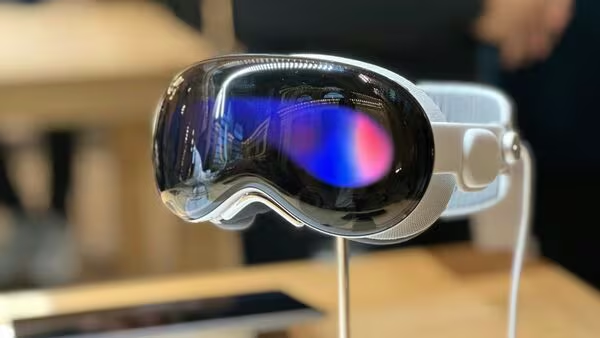
Apple officially shattered the barrier between high-end spatial computing and the everyday consumer. In a surprise digital keynote, CEO Tim Cook unveiled the Apple Vision Air, a sleek, lightweight augmented reality (AR) headset designed to bring the power of the Vision Pro to the masses.
Priced at a strategic $999, the Vision Air represents Apple’s most aggressive move yet to transition from the “Pro” era of bulky headsets to a future where digital overlays are as common as wearing a pair of sunglasses.
Design: Moving from ‘Helmet’ to ‘Glasses’
The most striking feature of the Vision Air is its form factor. While the original Vision Pro was often criticized for its weight and external battery tether, the Vision Air has undergone a radical “slimming down” process.
- Weight Reduction: By utilizing a magnesium alloy frame instead of titanium and glass, Apple has reduced the weight to a mere 150 grams.
- Integrated Power: The “Magic Battery” pack is gone. The Vision Air uses a distributed battery system built into the reinforced stems of the glasses, providing a 4-hour active battery life, which can be extended via a magnetic USB-C neck strap for all-day use.
- Optic ID 2.0: The sensors have been miniaturized and tucked into the bridge of the nose, allowing for a design that looks significantly more like high-end eyewear than a piece of scuba gear.
The “Spatial Collaboration” Breakthrough
The “killer feature” of the Vision Air is Spatial Collaboration. Unlike the Vision Pro, which focused heavily on immersive entertainment and solo productivity, the Air is built for the “Glowmad” and the remote professional.
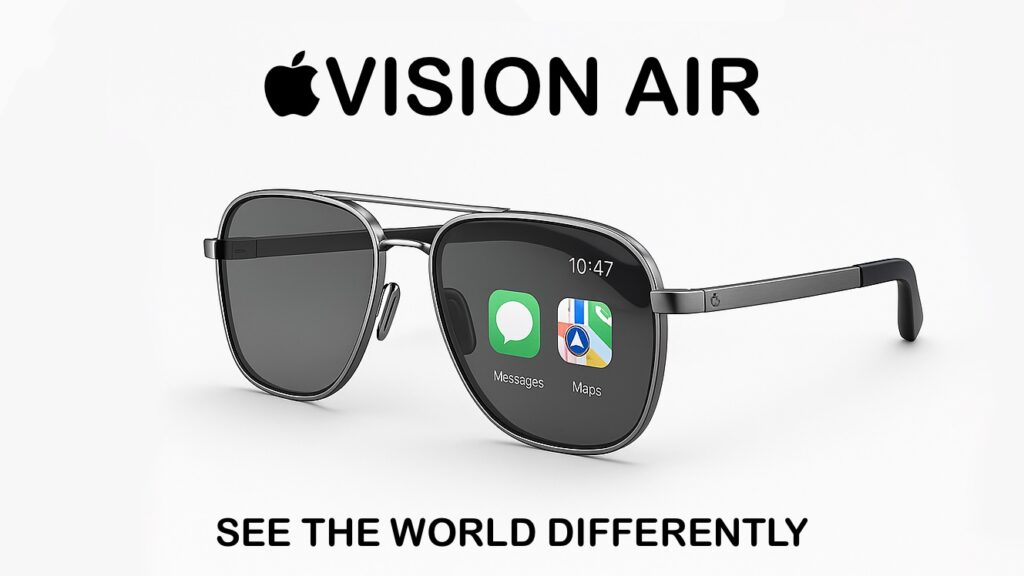
Using the new M3 Air chip, the device allows multiple users to project a shared holographic workspace onto any flat surface—be it a coffee shop table in Accra or a boardroom in New York. Two people wearing Vision Air glasses can see the same 3D model or spreadsheet between them, interacting with it using natural hand gestures. There is no lag, and the “World Anchoring” technology ensures the digital object stays fixed to the table even if the users move around the room.
The Ecosystem Play: iPhone as the Brain
To achieve the $999 price point and the light weight, Apple has shifted much of the heavy processing to the iPhone 16 and 17 series. The Vision Air connects wirelessly via a new “Ultra-Wideband 3” (UWB3) protocol, using the iPhone’s GPU to render complex environments while the glasses handle the low-latency display and head tracking.
This “tethered-wireless” approach allows the Vision Air to remain cool to the touch and incredibly thin, effectively making it the ultimate iPhone accessory.
Market Impact: A Threat to Meta and Google
The tech world has reacted with immediate volatility. Shares of Apple (AAPL) jumped 3.2% within an hour of the announcement. Analysts believe the $999 price point is the “sweet spot” that will finally move AR out of the enthusiast niche and into the mainstream.
Competitors like Meta, whose Quest series has focused on VR gaming, now face a direct threat in the “lifestyle AR” category. Google, which has been quiet since the sunsetting of Google Glass, is rumored to be fast-tracking its partnership with Samsung to counter Apple’s move.
Privacy and the “EyeSight” Controversy
Apple has doubled down on privacy with a physical “Recording” LED that glows bright amber when the cameras are active. They have also refined the EyeSight feature—the external display that shows the user’s eyes. In the Vision Air, it is more subtle, using a “ghosting” effect that makes it look like the lenses are slightly translucent, reducing the “social uncanny valley” effect of the original Pro model.
Availability
Pre-orders for the Apple Vision Air open on February 20, 2026, with shipping expected to begin in late March. In Ghana and other emerging markets, authorized resellers are already seeing a surge in inquiries as the device is expected to revolutionize remote tech work across the continent.