The date June 7, 2026, will be remembered as a massive turning point in the modern history of Real Madrid Club de Fútbol. For the first time in two decades, the club’s members (socios) queued around the Basketball Pavilion at Ciudad Real Madrid in Valdebebas to cast their votes in a contested presidential election. Since Ramón Calderón’s controversial victory back in 2006, the formidable Florentino Pérez has run entirely unopposed, cruising through the 2013, 2017, 2021, and 2025 electoral cycles without facing a single challenger.
That streak of absolute authority came to a sudden halt this summer. Driven by back-to-back trophy-less seasons in domestic and European competitions, the 79-year-old Pérez took the aggressive step of calling early elections to challenge his detractors. What he did not expect was a fierce, well-funded challenge from 37-year-old renewable energy tycoon Enrique Riquelme. This election quickly shifted from a routine referendum on Pérez’s historic legacy into a deep ideological war over the soul, ownership, and management of the world’s most valuable football club.
Why Did Florentino Pérez Call an Early Election?
To understand how Real Madrid reached this point, one must look at the immense pressure building within the Santiago Bernabéu. Despite completing a stunning multi-billion-euro stadium renovation, the team’s on-field performance has stagnated sharply. The club just concluded a highly disappointing season completely devoid of major silverware—missing out on La Liga, the Copa del Rey, and the UEFA Champions League.
This followed a similarly flawed prior campaign where the club only managed to secure minor silverware like the UEFA Super Cup and the FIFA Intercontinental Trophy. A painful Champions League quarter-final exit at the hands of Bayern Munich, paired with intense dressing room drama—including a highly publicized physical altercation between Aurelien Tchouameni and Federico Valverde—shattered the team’s internal harmony. Furthermore, fan dissatisfaction grew due to the perceived lack of defensive work rate from marquee star Kylian Mbappé.
In response to growing media criticism and whispers of an internal coup, Pérez held a defiant press conference on May 12, 2026. He explicitly dared his hidden opponents to come out of the shadows, immediately triggering an early election cycle.
The Challengers: Elite Power vs. Modern Disruption
Florentino Pérez: The Incumbent Institutional Dynasty
Florentino Pérez represents the establishment. First elected in 2000 after engineering the legendary capture of Luís Figo from arch-rivals Barcelona, Pérez defined the famous Galácticos era. Across his two distinct tenures (2000–2006 and 2009–present), he turned Real Madrid into a commercial machine and secured six Champions League trophies. Backed by high-profile endorsements from club legends like Gareth Bale, Roberto Carlos, Karim Benzema, and Luka Modrić, Pérez focused his campaign entirely on stability, institutional prestige, and his historic track record.
Enrique Riquelme: The Reformist Outsider
Enrique Riquelme, the young billionaire president of Cox Energy, launched a direct attack against Pérez’s long-standing monopoly. To even qualify for the ballot, Riquelme had to bypass strict electoral hurdles originally implemented by Pérez himself. These rules require candidates to have 20 consecutive years of club membership and present a personal financial guarantee of 15% of the club’s annual budget—amounting to a massive €187 million bank bond backed entirely by personal assets. Riquelme easily cleared these high financial requirements, presenting himself as a modern, data-driven alternative to Pérez’s traditional governance.
The Great Ideological Debate: Club Privatization
The central debate of this election centered on club ownership and financial models. Real Madrid has historically operated as a non-profit sports association owned entirely by its 100,000 socios. However, Pérez shook up the fan base by introducing a structural proposal to sell a 5% private equity stake in the club.
- Pérez’s Argument: He asserts that selling a tiny corporate fraction allows financial markets to establish a concrete valuation of the club. Under his vision, this equity would be converted into tangible corporate shares distributed directly to the members, shifting them from mere voters into actual equity shareholders.
- Riquelme’s Resistance: Riquelme built his campaign around blocking this initiative, labeling privatization a dangerous “red line” that must never be crossed. He warned members that introducing outside private capital is the first step toward losing fan ownership, risking a future where foreign billionaires or sovereign wealth funds take control of Real Madrid.
Managerial Appointments: The Special One vs. The German Revolution
The candidates also presented completely opposing plans for the manager’s hot seat, following the sacking of Xabi Alonso and the interim status of Álvaro Arbeloa.
+-------------------+----------------------------+----------------------------+

| Tactical Feature  | Florentino Pérez Platform  | Enrique Riquelme Platform  |
+-------------------+----------------------------+----------------------------+

| Manager Choice    | José Mourinho              | Jürgen Klopp               |
| Primary Transfer  | Michael Olise (€150m)      | Erling Haaland             |
| Defensive Focus   | Ibrahima Konaté (Free)     | Rodri                      |
| Fullback Target   | Denzel Dumfries            | Core Academy Integration   |
+-------------------+----------------------------+----------------------------+
The Return of José Mourinho
Pérez decided to lean heavily into nostalgia and iron-fisted discipline by confirming an agreement with current Benfica boss José Mourinho. Mourinho, who managed Madrid during a highly volatile period between 2010 and 2013, is envisioned as the perfect manager to clean up dressing-room divisions, instill tactical focus, and handle intense media scrutiny.
The Vision of Jürgen Klopp
Riquelme countered this nostalgic choice by looking to German tactician Jürgen Klopp. He promised that Klopp’s high-energy style would instantly revitalize the squad’s low work rate, maximize Mbappé’s attacking output, and build a sustainable long-term project centered on continuous high-pressing football.
Transfer Window Promises: War of the Galácticos
No Real Madrid presidential election is complete without spectacular transfer promises. The 2026 campaign delivered some of the most expensive transfer pledges in football history.
Pérez’s Targeted Spending
Pérez structured his transfer platform on calculated, high-impact spending. He confirmed plans to launch a massive €150 million bid for a premium Champions League attacker, heavily reported by internal sources to be Bayern Munich’s versatile forward Michael Olise. To balance out this high expenditure, Pérez aimed to reinforce the defense by securing free-agent French center-back Ibrahima Konaté alongside a move for Inter Milan’s dependable fullback Denzel Dumfries.
Riquelme’s Manchester City Raid
Riquelme went all out by announcing that he secured a legally binding, notarized guarantee to sign Erling Haaland directly from Manchester City. Despite immediate public denials from Haaland’s father and agent, Riquelme stood firm, comparing the denials to the exact media smoke screens that occurred during the historic Luís Figo deal in 2000. To complement Haaland, Riquelme promised to bring Ballon d’Or winner Rodri back to Madrid to anchor the midfield.
The Verdict: Election Night in Valdebebas
Despite a highly aggressive campaign from Riquelme, changing the leadership at the Bernabéu proved to be an impossible task. Voting booths closed at 8:00 PM local Spanish time under tight security monitored by the official Electoral Board.
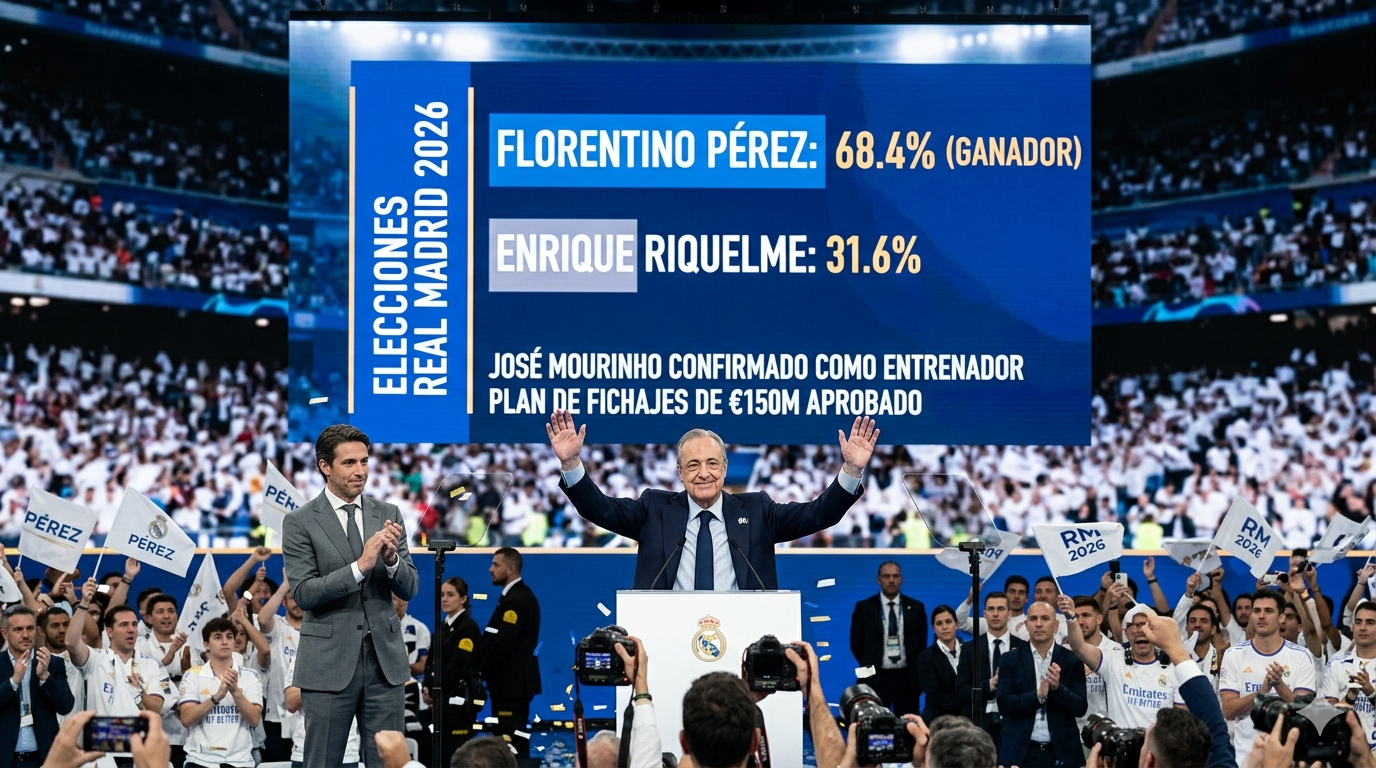
Early projections and initial tallies reveal a clear, decisive victory for the incumbent president. Florentino Pérez has been re-elected as President of Real Madrid, capturing a dominant 66.53% of the vote, while Enrique Riquelme finished with 33.47%.
While Riquelme’s reformist campaign failed to pull off a historic upset, sports analysts note that he has successfully positioned himself as the clear heir-apparent for the post-Pérez era. Capturing over a third of the total vote against the most successful president in modern football history shows that a significant portion of the socios are looking for structural change.
For now, Florentino Pérez retains his presidential seat until 2030. With his authority firmly renewed by the members, the old master now faces the immediate task of fulfilling his grand promises: finalizing the return of José Mourinho, launching the €150 million summer transfer bid, and navigating the complex debate over the club’s financial future. One thing is absolutely certain—the summer transfer window at the Santiago Bernabéu will be incredibly exciting.